How a Restaurant Group Turned Google Searches Into Restaurant Visits
Search visibility only matters if it leads somewhere. Here is what happened when one restaurant group's customers found them on Google.
How a Restaurant Group Turned Google Searches Into Restaurant Visits
Most marketing reports talk about impressions. Impressions are easy to grow and hard to eat.
The better question for a restaurant is simpler: did anyone actually come?
The challenge
Our client is a well-known restaurant group operating four branches across the Kathmandu Valley. The client's name has been withheld at their preference.
For a multi-branch restaurant, being visible online is only half the job. A hungry customer searching on their phone needs to decide three things quickly: what to eat, which branch to visit, and how to get there. If any of those takes too long, they choose somewhere else.
So the goal was never visibility for its own sake. It was to shorten the distance between a search and a seat.
What we focused on
- Organic SEO and first-page visibility for local restaurant searches
- Google Business Profile optimization for each branch separately
- Making menus, phone numbers and directions reachable in one tap
- Website engagement and clear contact pathways
- Visibility in AI-generated search results
What happened in August
Across the four branches, the Google Business Profiles generated 9,260 customer actions in a single month.
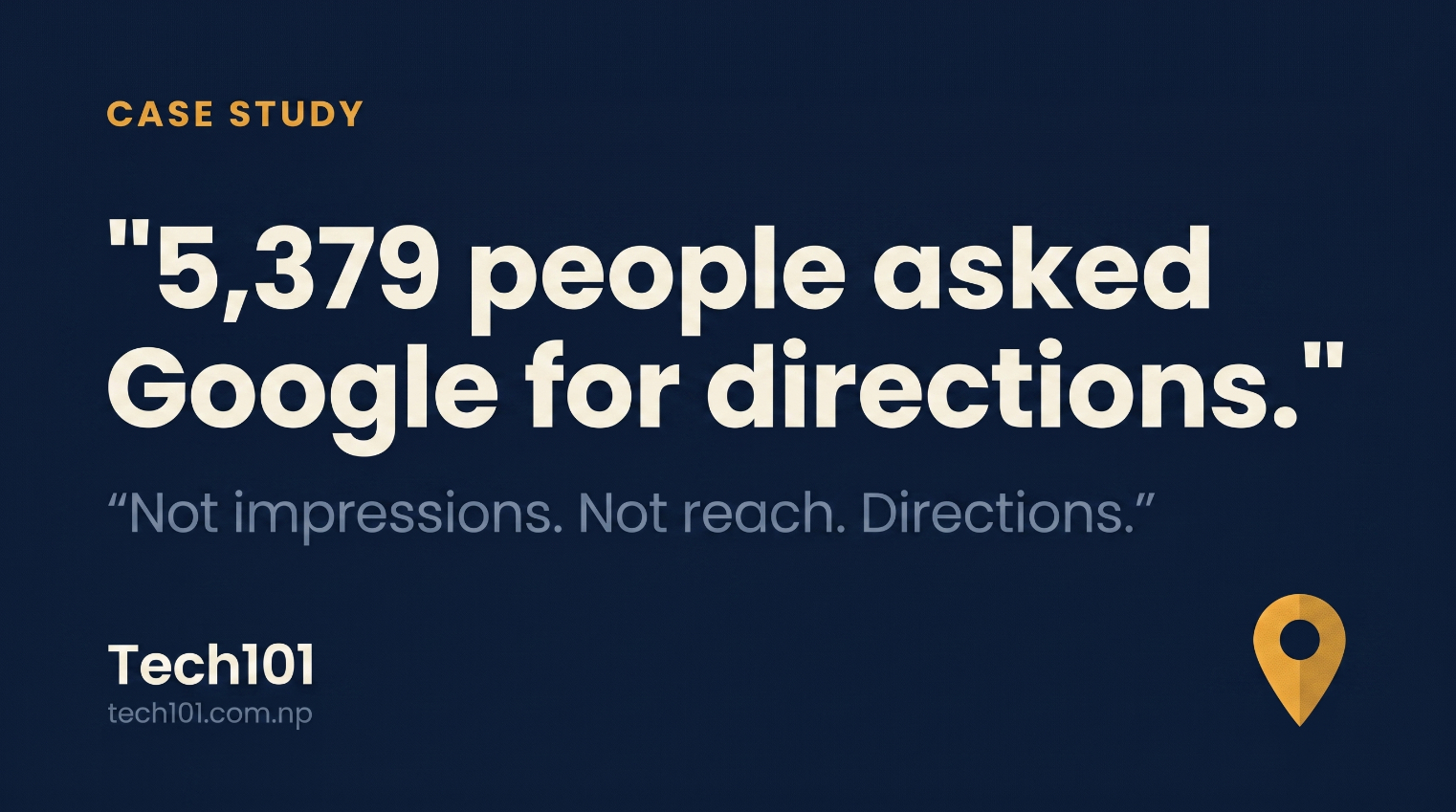
More than half were direction requests — over five thousand people asking Google how to get to a branch. That is not awareness. That is someone already in the car.
| Action | Count |
|---|---|
| Direction requests | 5,379 |
| Menu clicks | 2,324 |
| Phone calls | 1,179 |
| Website clicks | 378 |
Search performance supported it: 138,000 search impressions, 4,590 organic clicks, and an average position of 5.3 — appearing near the top of page one for the searches that mattered.
Why direction requests matter more than impressions
There is a natural order to how a customer decides where to eat:
Search → Reviews → Menu → Call or Directions → Visit
Each step filters people out. Impressions sit at the very top of that funnel, where almost everyone is still undecided. Direction requests sit at the bottom, where the decision has effectively been made.
That is why we report the second number rather than the first.
Trust did quiet work in the background
The group's public profiles carried a substantial base of customer reviews, with strong ratings across every branch.
For a customer choosing between two restaurants, that is often the deciding factor before they ever open the menu.
The branch picture
| Branch | Interactions | Menu clicks | Calls | Directions |
|---|---|---|---|---|
| Branch A | 2,686 | 613 | 352 | 1,594 |
| Branch B | 2,318 | 612 | 212 | 1,414 |
| Branch C | 2,197 | 537 | 301 | 1,271 |
| Branch D | 2,059 | 562 | 314 | 1,100 |
Each branch was treated as its own local business, because that is how Google sees them — and more importantly, how customers search.
Appearing in AI search
The brand also recorded 11,300 impressions in generative AI search results.
This is new territory. More people are now asking an AI assistant where to eat rather than typing into a search box. Businesses structured well for traditional search tend to appear in those answers too. We are watching this closely, because we expect it to matter a great deal over the next two years.
What this means for any local business
Treat every location as its own business. Four branches means four profiles, four sets of photos, four sets of reviews.
Make the next step obvious. A customer hunting for your menu or address is already comparing you to someone else.
Reviews are marketing. They work while you sleep, and no advertising budget replaces them.
Measure actions, not attention. Calls, directions and menu views tell you something real. Impressions tell you almost nothing.
A note on honesty: direction requests, calls and menu clicks are strong signals of intent, not confirmed visits. We report them as what they are.
Tech101 is a digital agency in Kamaladi, Kathmandu, helping businesses across Nepal grow through SEO, websites, social media and digital marketing. Data: 1–31 August 2026, published with the client's permission.